WORLD ENVIRONMENT DAY (WED) 2025

James_New Olatunji
July 26, 2025
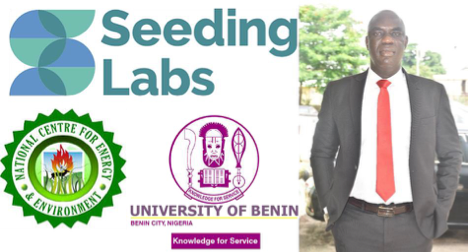
The National Centre for Energy and Environment (NCEE), a research Centre of the Energy Commission of Nigeria (ECN) located at the University of Benin (UNIBEN), has been selected as one of the institutions to benefit from the prestigious Seeding Labs’ Instrumental Access Grant Award, involving the donation of laboratory equipment and supplies that will advance teaching, scientific research, and academic development of the Institution. Through this award, the Centre will receive state-of-the-art laboratory equipment and supplies valued in multimillion naira, aimed at strengthening scientific research, enhancing teaching, and advancing academic development. The fifty-five-year-old University is the newest awardee selected to receive scientific equipment from Seeding Labs’ Instrumental Access program worth $300,000-$400,000 in a 20ft-shipping container.
Seeding Labs Instrumental Access is an initiative that makes high-quality laboratory equipment and supplies available to departments in universities and research institutes in developing countries, and it is the flagship program of Seeding Labs, a US-based NGO working to increase access to resources for science in developing countries.
Interestingly, National Centre for Energy and Environment was chosen for the Instrumental Access award after a rigorous and competitive selection process that receives and evaluates applications from institutions around the world. To be considered for the Grant, applicants outline the ways that an infusion of scientific equipment would remove barriers to STEM education and research at their institutions—paving the way for new avenues of scientific inquiry and expanding hands-on opportunities for students. Thus, the intervention provides a foundation for other critical resources that allow scientists to generate new knowledge, leverage sustainable funding, and better prepare university students for the scientific workforce and innovation economy.
To date, the Instrumental Access program has catalyzed scientific innovations at more than 100 universities and institutions in 39 developing countries. Particularly, the intervention has enhanced workforce training for more than 230,000 students, who have access to Instrumental Access equipment in practical lab sessions and thesis research; catalyzed research projects with $16.9 million of new funding across 69 universities; and given more than 2,900 scientific staff in 118 departments at different universities more opportunity to pursue their research endeavours, among other notable impacts.
About the National Centre for Energy and Environment, University of Benin
The National Centre for Energy and Environment (NCEE), established in 2009, is one of the specialized research Centres of the Energy Commission of Nigeria (ECN) and is strategically located at the University of Benin (UNIBEN). The Centre serves as a hub for cutting-edge research, innovation, and policy development in energy and environmental sustainability. Its mandate spans multidisciplinary research and development (R&D) in renewable energy, environmental conservation, waste-to-energy systems, climate change mitigation, and eco-friendly technologies. Through these efforts, the Centre plays a critical role in advancing Nigeria’s transition to clean energy while addressing pressing environmental challenges with scientific and practical solutions.
The University of Benin, host institution to the Centre, is one of Nigeria’s first-generation federal universities established in 1970 by the Federal Republic of Nigeria. It was founded to broaden equitable access to higher education while also supporting Nigeria’s development aspirations by producing quality manpower and building a robust knowledge base to drive national competitiveness. Located in the South-South geopolitical region, Nigeria’s oil-rich zone, UNIBEN has become one of the fastest-growing universities in the country and remains one of the most sought-after institutions by candidates pursuing undergraduate and postgraduate education.
In securing the Seeding Labs’ Instrumental Access Grant, the National Centre for Energy and Environment’s Director, Dr. Emmanuel Temiotan Ogbomida, played a pivotal role. Dr. Ogbomida, formerly Director of Research, Innovation, and Consultancy at Copperbelt University, Zambia, is also a Visiting Research Scientist and Associate Professor at Hokkaido University, Japan. His distinguished work in energy and environment, ecotoxicology, and environmental forensics, along with his track record in forging impactful academic partnerships, positioned him as a strong facilitator for the award. Notably, he pioneered the establishment of the Mukumba University Innovation Pod (UniPod) at Copperbelt University in collaboration with the UNDP Accelerator Lab.
Receiving the news of the award with great excitement, both Professor Omoregie, Vice-Chancellor of UNIBEN, and Dr. Abdullahi, Director General of the ECN, expressed profound appreciation for the grant. They emphasized that the donation would significantly improve the standards and quality of teaching and research at the Centre and across the University.
Speaking on the significance of the award, Professor Omoregie and Dr. Abdullahi remarked: “Under our leadership as Vice-Chancellor and Director General, and with Dr. Emmanuel Temiotan Ogbomida’s academic and scientific leadership, this equipment will be deployed strategically and judiciously to strengthen research capacity, foster innovation, and drive societal impact.”
About Seeding Labs
Seeding Labs is a Boston-based NGO that increases access to resources for science in developing countries. Seeding Labs has built a coalition of more than 230 public and private sector partners to provide scientific institutions in developing nations with lab equipment, training, and opportunities to collaborate with experts in their field—and to create a world where science and the institutions that sustain it can thrive everywhere, illuminating a brighter and healthier future for all.
As of February 2024, Seeding Labs has shipped 365 tons of lab equipment to 110 institutions in 39 countries around the world. Additional information on Seeding Labs and Instrumental Access is available at http://seedinglabs.org/ on Facebook at Facebook.com/SeedingLabs; and on Twitter at @SeedingLabs.
Seeding Labs’ social media handles: Twitter: https://twitter.com/SeedingLabs l Facebook: https://www.facebook.com/seedinglabs l LinkedIn: https://www.linkedin.com/company/seeding-labs/