
About Us
- Home
- About
About Us
The National Centre for Energy and Environment (NCEE) is one of the six research Centres under the Energy Commission of Nigeria. The Centre was established on March 12, 2009 with the appointment of the pioneer Director, Prof. Lawrence Ikechukwu Ezemonye. The Centre is charged with the responsibility of organizing and conducting research and development programmes in Bioenergy and Environment.
The establishment of the Centre was through the accent of the 2009 appropriation bill by the late President and Commander-in-Chief of the Federal Republic of Nigeria, Umaru Musa Yar’adua, GCFR. The Centre was officially commissioned on August 25, 2009 and the Administrative Block Complex was commissioned on August 30, 2012 by the DG/CEO, Energy Commission of Nigeria (ECN) and Special Adviser to the President on Energy, Prof. Abubakar Sani Sambo FAS, OON, NPOM. The Centre is located within the Ugbowo campus of the University of Benin, Benin City.
Our Mission
We shall promote sustainable, renewable energy sources through research and development initiatives in Bio-energy production and Environmental Forensics/Management.
Our Vision
The Centre shall be organized as a platform for promoting cutting-edge research and development and pioneer new renewable energy technology.
Our Mandate
MANDATE OF THE CENTRE
The Centre is charged with the responsibility of organizing and conducting research and development programmes in bioenergy and environment.
Conducting research and development in renewable energy technologies, bioenergy, and waste-to-energy innovations.
Providing technical support and advisory services to policymakers, industries, and other stakeholders on energy and environmental sustainability.
Promoting capacity-building programs, knowledge dissemination, and public awareness campaigns on energy and environmental issues.
Collaborating with national and international organizations to advance research and development in energy and environmental sectors.
Supporting the implementation of Nigeria's energy policies and strategies in alignment with the Sustainable Development Goals (SDGs).
Our Objectives
Objectives of the Centre
To effectively achieve its mandate, the NCEE pursues the following key objectives:
- Advancing Research and Innovation: The Centre focuses on developing innovative solutions for energy generation, conservation, and environmental management. It particularly prioritizes the exploration of renewable energy sources such as solar, wind, biomass, and biofuels to diversify Nigeria’s energy mix and improve sustainability.
- Promoting Environmental Sustainability: The NCEE actively engages in research on carbon capture technologies, environmental remediation techniques, and ecological conservation. It addresses critical environmental challenges like waste mismanagement, pollution, and the degradation of natural resources.
- Capacity Building and Education: The Centre is dedicated to training the next generation of energy and environmental professionals. It organizes workshops, seminars, and conferences to share knowledge, strengthen stakeholder capacity, and foster education in these critical areas.
- Fostering Collaboration and Partnerships: The NCEE collaborates with academic institutions, government agencies, industries, and international organizations. This network enhances the Centre’s ability to conduct high-impact research, secure funding, and expand its reach, ultimately benefiting the broader community.
- Supporting National Policies: The Centre’s work is aligned with Nigeria’s energy and environmental policies. It provides research-based recommendations to guide policy decisions and contributes to the effective implementation of national strategies for sustainable development.
Our Functions
FUNCTIONS OF THE CENTRE
As a National Research Centre focused on Bioenergy and Environmental Sustainability, to achieve its aim the Centre performs the following critical functions:
Policy Development:
Develop guidelines for short, medium, and long-term policies on research initiatives in bioenergy production and environmental management.
Promote Renewable Energy Technology (RET):
Support and sustain renewable energy technology research and development programs.
Biomass Research and Technology Transfer:
Identify and harness the potentials for biomass research, production, and technology transfer, focusing on biofuels and biogas.
Environmental Research Platform:
Serve as a platform for environmental research initiatives in energy production and carbon emission control.
High-Level Manpower Training:
Facilitate training in waste-to-energy technologies, including biofuel, biogas, and biomining.
Pilot Demonstration Projects:
Develop and execute pilot projects showcasing the potentials of biofuel production and waste-to-energy programs.
Knowledge Sharing:
Share knowledge, skills, and tools from research through workshops, conferences, seminars, and media engagements with stakeholders such as policymakers, industry experts, academics, and regulators.
Standardization and Quality Assurance:
Oversee the standardization, quality assurance, and monitoring of research and development activities in bioenergy production.
Collaborative Research and Commercialization:
Encourage collaborative research with institutions and industries to promote the commercialization of research and development outcomes.
Public Awareness and Dissemination:
Disseminate research findings and innovations through public awareness programs, including seminars, conferences, workshops, and publications.
Additional Functions:
Perform any other functions as directed by the Federal Government.
RESEARCH, INNOVATION AND DEVELOPMENT HIGHLIGHTS
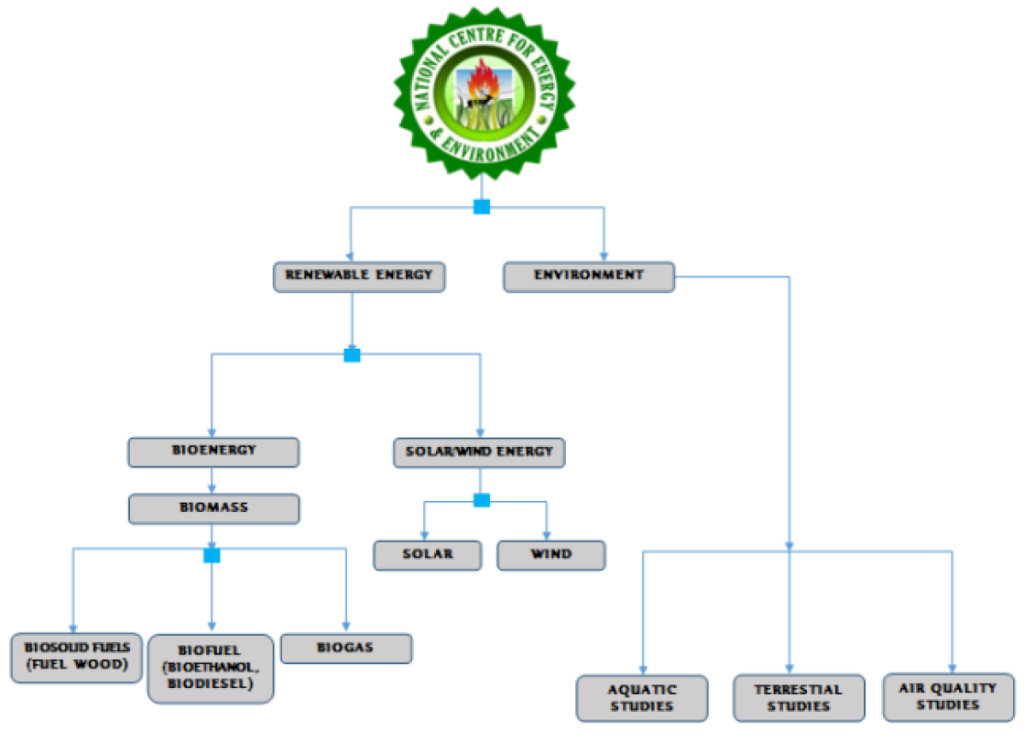
Organizational Chart Depicting the Research Focus Areas of the Centre.
RESEARCH FOCUS AREAS
RESEARCH FOCUS AREAS OF THE CENTRE
The Centre’s research activities are strategically guided by the Director General, Centre Management, and the Technical Advisory Board, ensuring that all initiatives align with national energy and environmental priorities. The Centre focuses on the following key research areas:
Biofuel Research and Development
i. Enhancing the production and utilization of bioethanol and biodiesel. ii. Assessing the viability of integrating biofuels into Nigeria’s energy mix.
Biomass Production from Agricultural and Animal Wastes
i. Exploring the potential of crop residues, animal manure, and other organic wastes for energy generation. ii. Developing sustainable biomass-to-energy conversion technologies.
Waste-to-Energy Research and Development
i. Investigating municipal and industrial waste-to-energy solutions.
ii. Promoting biogas and biomass gasification technologies for decentralized power generation.
Solar and Wind Energy Research
i. Advancing solar photovoltaic (PV) and thermal energy applications for rural and urban electrification.
ii. Studying wind energy potential and hybrid systems for sustainable power generation.
Biomass, Gene Pool, and Resource Management
i. Identifying and conserving bioenergy feedstocks and genetic resources.
ii. Promoting sustainable land-use practices for biomass cultivation.
Environmental Forensics, Carbon Capture, and Remediation
i. Investigating pollution sources through environmental fingerprinting and forensic techniques.
ii. Developing carbon capture and utilization (CCU) systems for reducing industrial emissions.
iii. Conducting remediation research to address oil spills, water pollution, and land degradation.
Legal Framework for Renewable Energy Research and Development
i. Developing policy recommendations for renewable energy regulation and implementation.
ii. Engaging with government agencies and stakeholders to create a conducive legal environment for clean energy adoption.