The National Centre for Energy and Environment (NCEE)

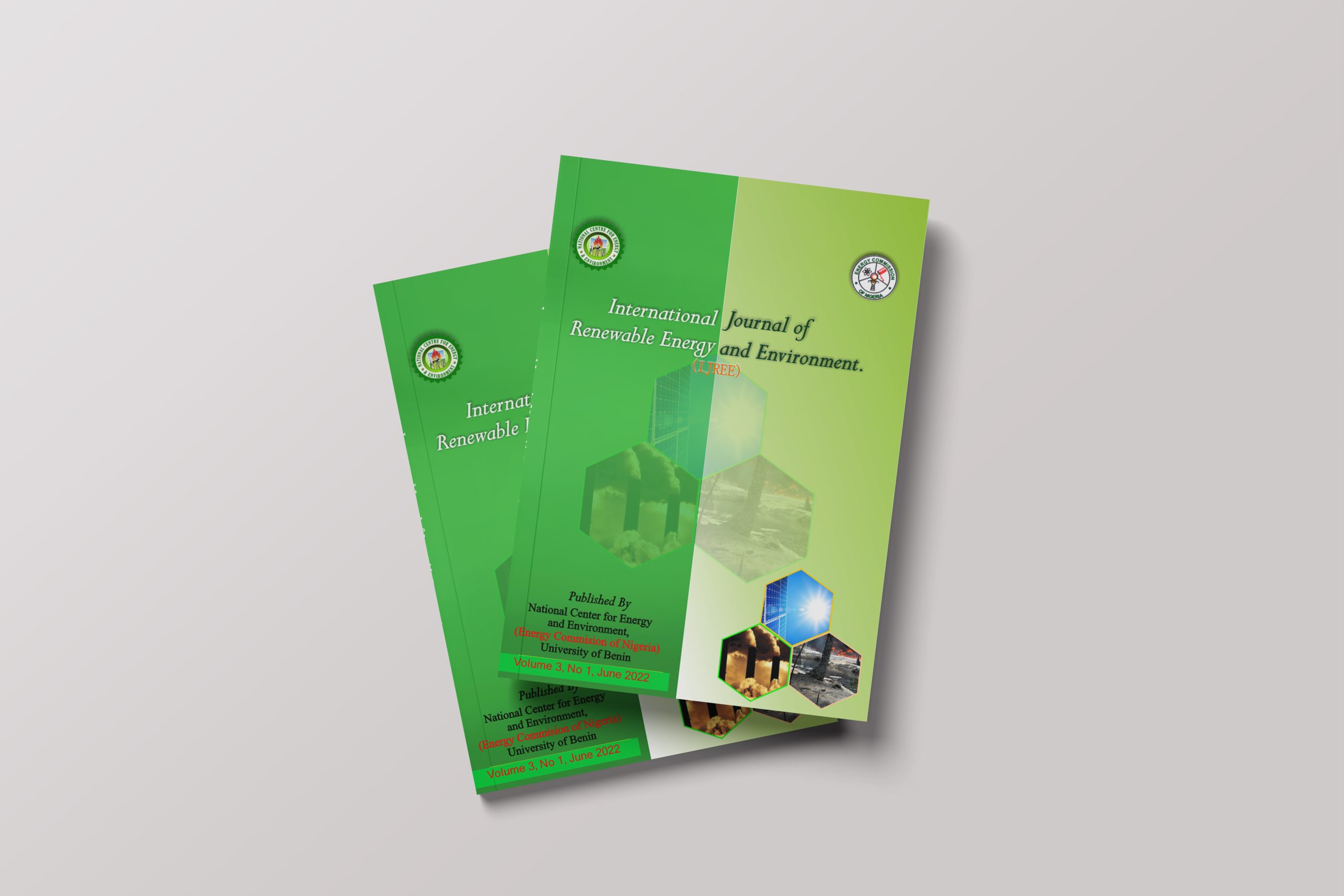
International Journal of Renewable Energy and Environment (IJREE)​

OVERVIEW

The International Journal of Renewable Energy and Environment (IJREE) is a publication of the National Centre for Energy and Environment. The Journal contains scientific research into all aspects of Renewable Energy resources, their interaction with the environment and relationship with man.

This journal is multidisciplinary in approach and interdisciplinary in scope promoting findings in a wide range of subject areas: Renewable Energy Technology, Agricultural Engineering Technology, Biomass Feedstock and Conversion, Environmental Forensics, Environmental Law and Policy, Environmental Management, Human Health and Lifecycle Assessment, Biological Modelling, Environmental Engineering, Energy Efficiency, Climate Change and Carbon Capture Technology.
In view of the multidisciplinary nature of the journal, the Editorial Board and Editorial Advisory Committee are made up of a broad spectrum of internationally recognized scientist, academicians and policy makers who will encourage publications that display only the highest standards of international scholarship.


  • IJREE Volume 1
  • IJREE Volume 2
  • IJREE Volume 3
  • IJREE Volume 3(b)

Pragmatic Approach to Biodiesel Production using Jatropha Curcas oil. C.S. Ezeanyanaso, I.M. Bugaje and O.J. Okunola – page 1

Studies of some of the factors affecting base-catalyzed transesterification of rubber seed oil.  John Edo and T.O.K. Audu – page 9

Novel solid-acid catalysts for biodiesel production from waste cooking oil. James O. Ugbomoiko, David E. Ogbeifun and Felix E. Okieimen – page 17

Inventory of farms involved in livestock production in Edo and Delta States and their potentials as sources of animal waste biomass for energy generation and biogas production.  J.M. Olomu,  S.O. Nwokoro, A.M. Orheruata,  C.E. Okaka, C.P. Kalu, D.I. Igbinomwahia, U. Ochei,  D.N. Izekor and S.O. Okhokere – page 31

Comparative Assessment of Poultry Droppings/Litter and Swine Faeces as Feedstock for Biogas Production. C. Olomu, E. Ifie, E. Kegbe, E. Ezieshi,  L.I.N. Ezemonye and J.M. Olomu – page 40

Comparative assessment of the effect of water soluble fractions of fuel oils on microalgae. M.O. Kadiri and M. Enoma – page 48

Ecotoxicological Consideration of Demulsifier, Corrosion Inhibitor and drilling fluid    using Biological Sentinels. D.F. Ogeleka, L.I.N. Ezemonye, I. Tongo, A.A. Enuneku, T.O. Ikpesu and T.E. Ogbomida – page 56

Biochar from Prosopis africana shell and Palm Kernel Seeds: Physical, Chemical and Adsorption Properties. Sunday E. Elaigwu and Gillian M. Greenway – page 62

Soil application of biochar. Effect on soil nutrient retention capacity. Victoria O. Idode and Felix E. Okieimen – page 67

Instantaneous control of mini/micro hydro plants generated output voltage under varying load conditions. Igbinovia, S.O. and R.E. Ochagwuba – page 77

Socio-economic implications of renewable energy in climate change adaptation. L.I.N. Ezemonye and C.F. Okolocha – page 86

Operation of large hydropower dams in Nigeria: Socio-economic and environmental issues.  B.F. Sule – page 100

Efficient cost Estimation Of electric Energy Utilization: Using load Management Method. N. Bello and S.O Igbinovia. page 1-11

Evaluating the Performance Characteristics of Locally Designed and Implemented Condensers Suitable For Electric Circuits  F. O. Agbontaen, S.O. Igbinovia and F. O. Osayi. page 12-21

Statistical Analysis of Wind Energy Potential In Benin City Using the 2-Parameter Weibull Distribution. P. Osatohanmwen,  F.O, Oyegue,  S.M Ogbonmwan. page 22-31

Biogas Production From a Blend Of Water Hyacinth -Eichhorniacrassipes (Martius) Solmslaubach (Pontederiaceae) And Cattle Rumen Waste (Dung) U. M. Ajieh, U. P Onochie, B. F Kubeyinje, R.T Orerome, O Akingba. page 32-41

Impacts Of Renewable Energy Option On Ecosystem And  Livelihood. O. Olokede, N.T Musa, B.G Adisa, L Ikenna-Mark. page 42-49

Energy Technology And Management For Sustainable Development. T.B. Ibraheem, D.A. Adeleke, A.I. Ibrahim, S. Haruna. page 50-55

Characterization Of Polycyclic Aromatic Hydrocarbons In Soil And Earthworm (Aporrectodea Longa) In The Vicinity Of Two Automobile Workshops In Benin City. E. Biose, S.O. Dieta, A.A Enuneku. Page 56-64

Sedimentation Studies Of Owena Multipurpose Reservoir. J.O. Aribisala, F. Adetanmi, O. M. Ogundipe. page 65-80

Ontological Representation Of Nigeria Wildlife. G. O. Ekuobase, F.O. Oliha, E. P. Ebietomere. page 81-92

Distillate Yield Improvement Using A Parabolic Dish Reflector Coupled Single Slope Basin Solar Still With Thermal Energy Storage Using Beeswax. A Kuhe, A. O Edeoja. page 93-101

Socio-Economic Determinants Of Household Energy Consumption Pattern In Benin City, Edo State, Nigeria. M.N  Ezemonye, C .N Emeribe. page 102-111

Comparison Of Physico-Chemical Characteristics Of Ethanol Yield Production From Palm Wine. O. Biose, M. Imhontu, O. Akenzua, C.N Emeribe, O. Ehigiamusoe. page 112-125

Appraisal Of Charcoal Production Drivers In Ibarapa Region, Oyo State, Nigeria. A. O. Daramola, A. O.Ayeni. page 126-138 

Changing Patterns In Seasonal And Annual Distributions Of Climatic Indices Over Sudano-Sahelian Ecological Zone (Ssez) Of Nigeria. L.I. Ezenekwe, M.N Ezemonye, C.N Emeribe. page 139-149

Analysis Of Trends In The Variability Of Monthly Mean Minimum And Maximum Temperature And Relative Humidity In Benin City. S.M. Ogbonmwan, E. T. Ogbomida, N. O. Uwadia, O. R. Efegoma, G. L. Umoru. page 150-165

Evaluation Of In-Cabin Levels Of Fine Particulates And Carbon Monoxide In Shuttle Buses Along A Major Intra-City Route In Benin City, Nigeria. E.W. Omagamre, J.E. Ukpebor, E.E. Ukpebor, G.E. Okungbowa,  E.H. Odionye. page 166-178

Design And Implementation Of Automatic Changeover Switch (With Step Loading) For Renewable Energy Systems. C.A. Osaretin, E.I. Ibhadode, S.O.  Igbinovia. page 179-192

Comparative Analysis Of Exhaust Gases From Generating Sets Powered By Biogas And Gasoline. J. O. Igbinawan; P. A. Oriaifo; E.A. Ogujor; F. A. Aisien. Page – 193-201

Economic Analysis On Power Generation From Oil Palm Residues: A Case Study Of Nifor. U. P Onochie, Aliu S. A. page 202-210

Changing Pattern of Rainfall Peak In The Sudano-Sahelian Region Of Nigeria. Godwin O. Atedhor. Page 211-221

Assessment of BTEX And Polycyclic Aromatic Hydrocarbons Concentrations in Shrimps From Benin River and Associated Risk From Consumption.  A.A Enuneku, O Ogbeide. L.I Ezemonye. E Omeniwa, S.I Idiahi. page 222-232

Green(Er) Biodiesel From Ternary PKO/DPK/AGO Blends. Sunday O. Aghariaha, Felix E. Okieimen. Page 233-239

Assessment of Electricity Supply Operation in Nigeria: A Case Study of University of Benin and University of Benin Teaching Hospital. F.O. Odiase , P.T Aikhoje., S.O Igbinovia. Page 240-249

Technical Power Losses Reduction on Distribution Network of University of Benin Teaching Hospital. O. F. Odiase and O.Agbonaye. Page 250-263

EVALUATION OF WIND ENERGY FOR POWER GENERATION IN BAUCHI STATE NIGERIA. 1 Samuel, M., 2 Muhammad, S U., 3 Sa’ad, A., 4Haruna, A.

A SYSTEMATIC REVIEW OF RADIONUCLIDE CONTAMINATION IN NIGERIAN FISH AND ITS IMPLICATIONS FOR PUBLIC HEALTH. 1,5*Ewuga, J. Ulu., 2, 5 Joshua, A. Samuel., 5 Aisha, A. Bello., 3,5Orkaa, M.Stephen., 4 Dakup, Y. Kitagak., 1 Daze, Z. Joseph

FORMS OF ORGANIC CARBON IN SOILS FROM ETSAKO EAST LOCAL GOVERNMENT AREA OF EDO STATE, NIGERIA. 1 Aigbovo, Nicholas Naruna, 2 Oviasogie, Philip Obasogie, 3 Oviawe, Amowie Philip

PLASTIC WASTES: AFRICA'S PERSPECTIVE IN ADDRESSING THE CRISIS AND INNOVATION FOR A SUSTAINABLE FUTURE *1Akingba, O.O, 2 Iyiola, A.O., 1Ogbomida, E.T., 1Emeribe, C.N.

THERMAL COMPETITIVENESS OF FURNACE BRICKS MADE FROM AGGREGATION OF SAND AND CLAYS SOURCED FROM OVIA, AFUZE AND OGHARA IN NIGER DELTA REGION OF NIGERIA Irogue, A. Wilfred* and Bashir, E Musa*

COMPARATIVE YIELD AND ANALYSIS OF ALCOHOL FROM SELECTED AGRICULTURAL PRODUCTS 1Aigbovo, Nicholas Naruna, 2Oviawe, Amowie.Philip.,1Peretiemo-Clark, Beatrice Oghenetega

Assessing Grid Stability Under Renewable Energy Penetration Using Data-Driven Simulations Modu Abba Gana1*, Abdulkadir. Ali Warude2, Abdullahi Bukar3

Comparative Analysis of the Performance of Batteries Aniru Abudu Muhammed and Hibah Imuentinyanose Muhammed

FRACTIONAL DISTRIBUSTION OF SOIL CONTAMINATED WITH LEAD NITRATE AND CADMIUM NITRATE USING SEQUENTIAL EXTRACTION METHOD 1AIGBOVO, Nicholas Naruna 2OVIAWE, Amowie Philip; 3OVIASOGIE, Philip Obasogie

MODELING SLOPE AND ASPECT INFLUENCE ON LANDSCAPE MORPHOLOGICAL CHANGE IN NDELE, RIVERS: A GIS-BASED ASSESSMENT 1Blessing Nesochi Godwin and 1Obinna Chidi Anyanwu

COMPARATIVE PERFORMANCE ANALYSIS OF MONOCRYSTALLINE, POLYCRYSTALLINE, AND THIN-FILM SOLAR PANELS UNDER VARYING SOLAR IRRADIANCE IN ABAKALIKI, EBONYI STATE, NIGERIA 1*Hyginus Arinze Alegu, 2Jonathan Chibueze Umunna, 3Vincent Nnamdi Amadi, 4Okechukwu Idika Ukairo, 5Emmanuel Nnaemeka Chukwu

ASSESSMENT OF AIR QUALITY AND NOISE LEVEL AROUND UNIVERSITY OF BENIN UGBOWO CAMPUS MAIN-GATE, BENIN CITY, EDO STATE NIGERIA. 1*Aigbovo, N. N., 2Ekhareafo, A. M., 2Idahosa, O. D., 2Okojie, I. O., 3Sukubo, I. G.

LAND USE/LAND COVER TRANSITIONS IN BENIN CITY AND IMPLICATIONS FOR MUNICIPAL SOLID WASTE MANAGEMENT 1Ubrei-Joe M.M., 1Rim-Rukeh, A., 1Ogunkeyede, A.

For Authors

  • Instructions to Author

Publishing a paper in IJREE requires Paper Processing Charges that cover dispatch and editorial expenses, and will be paid by the submitting author upon acceptance of the Paper for publication.

For ALL authors – All accepted manuscript will attract a publication fee of N40, 000. This covers Paper Processing Charges of N5, 000 and publication fee of N35,000

N.B: Submission of manuscript: All manuscripts are to be submitted through ijree@ncee.org.ng

  1. ORIGINAL RESEARCH PAPER

These should describe original, novel and carefully confirmed findings, and experimental procedures should be given in sufficient detail for others to verify the work. The length of a full paper should be the minimum required to describe and interpret the work clearly.

  1. SHORT RESEARCH COMMUNICATION

A short research communication should present a concise study, or timely and novel research findings that might be less substantial than a research paper. The manuscript length is limited to 2,500 words (excluding references and abstract). It should have a set of keywords and an abstract (under 200 words, unreferenced), containing background of the work, the results and their implications. Results and Discussion section should be combined and followed by conclusion. Materials and Methods will remain as a separate section. The number of references is limited to 40 and there should be not more than 4 figures and/or table combined.

  1. TECHNICAL NOTE

Brief description of new or modification of existing technique which mark major advances and are of practical value.

  1. REVIEWS

Brief or mini-reviews should be authoritative and of broad interest. Submission of mini-reviews and perspectives covering topics of current interest are welcome and encourage. Mini-reviews should be concise and no longer than 4-6 printed pages.

  1. LETTERS TO EDITORS

This is to discuss controversial and/or inter disciplinary topics, viewpoints and commentaries, brief description of novel finding that might not be suitable for a regular research paper or short research communication, and any other issues that might be of interest to our readers. It is limited to a maximum of 800 words (two print pages maximum). Letter can have one figure/table and maximum of 10 references.

FORMAT OF MANUSCRIPT

All portions of the manuscript must be typed double-spaced and all numbered starting from the title page. English is the preferred language all through contribution. Writing in French (with abstract in English) will be considered.

TITLE

This should be specific and precise. It should not be more than 2 to 3 lines long, and should describe the contents of the author’s full name and affiliations, then name of the corresponding author along with phone number, fax and Email information. Present addresses of authors should appear as footnote.

ABSTRACT

The abstract should be self-contained and citation free and should not exceed 150 words.

INTRODUCTION

This section should be succinct, with no subheadings. It should provide a clear statement of the problem, the relevant literature on the subject, and the proposed approach or solution. It should be understandable to colleagues from a broad range of scientific disciplines.

MATERIALS AND METHOD

Scientific details must be provided to allow for replication of results. Appropriate chemical names should be given and strains of organisms should be specified. Suppliers of materials need only be mentioned if this may affect the results. Use System International (SI) units and symbols. However, only truly new procedures should be described in detail; previously published procedures should be cited, and important modifications of published procedures should be mentioned briefly.

RESULT

This section should describe concisely the rationale of the investigation and its outcomes. Data should not be repeated in both a table and a figure. Tables and figures should be selected to illustrate specific points. Do not tabulate or illustrate points that can be adequately and concisely described in the next. Result should be explained, but largely without referring to the literature.

TABLES AND FIGURES

Tables and figures should be numbered (1,2,3 etc) as they appear in the text. Figures should preferably be the size intended for publication and should not exceed 9-12cm. Tables, figures and photographs should be carefully marked on the reverse side with the number, first author’s name and orientation (top). Legends should be typed double-spaced separately from figures. Photographs must be originals of high quality. Photocopies are not accepted.

DISSCUSSION

This should not simply recapitulate the results. It should relate to previous work and interpret them. Combined results and discussion sections are encouraged when appropriate.

ACKNOWLEDGMENT

This optional part should include a statement thanking those who assisted substantially with work relevant to the study. Grant support is included in this section.

REFERENCES

References to work “in press” must be accompanied by a copy of acceptance letter from the Journal. References should not be given to personal communication, unpublished data, Manuscripts in preparation, letter, Company Publications, Patent pending and URLs for websites. Abstracts of papers presented at meetings are not permissible. These references should appear as parenthetical expressions in the text.

Example

Ezemonye (2005), Ugbomoiko et al. (2012)

Ezemonye, L.I.N (2005). Polychlorinated biphenyls (PBCs) levels and distribution in Ethiope and Benin Rivers of the Niger-Delta surface water and sediments: International Journal of Environmental Studies 65:491-504

Ezemonye, L.I.N and Ilechie I., (2006). Ecological effect of pesticide contamination on amphibian tadpole (Ptychnadena bibroni) of the Niger-Delta of Nigeria. African Journal of Biotechnology, 28 (64)91-100

Ezemonye L.I.N, Ogeleka D.F. and Okiemen F.E. (2009). Lethal toxicity of industrial detergent on bottom devilling sentinels. International Journal of Sediment Research 24:478-482

SUBMISSION OF MANUSCRIPTS

All articles should be submitted online as a file attachment to ijree@ncee.org.ng. The papers should be typewritten in Times New Roman with font size 12, double spacing on A4 size Microsoft Word document. Maximum paper length is 18 pages.

COPYRIGHT
Submission of a paper for publication implies the transfer of the copyright from the author (s) to the publisher upon acceptance; and any accepted paper becomes the permanent property of the International Journal of Renewable Energy and Environment (IJREE) and may not be reproduced by any means without the written permission of the Editorial board. The copyright Agreement form can be downloaded below.

📄 IJREE Copyright Agreement Form

Editorial Board

EDITOR-IN CHIEF

Professor F. E. Okieimen

University of Benin, Benin City

EDITORIAL ADVISORY BOARD

Dr. Mustapha Abdullahi PhD,(Mech. Engrg); MIMechE

Director General/Chief Executive Officer

Prof. Gillian M. Greenway

University of Hull, UK

Prof. L. I. N. Ezemonye

University of Benin, Benin City.

Dr. Joseph C. Akunna

School of Contemporary Sciences Dundee, UK.

Prof. Kirk Semple

Lancaster University, UK.

Prof. B.O. Solomon

National Biotechnology Development Agency (NABDA), Abuja.

Dr. Martin Ogharandukun

Nuclear, Safety, Physical Security and Safeguards, Abuja.

Prof. E.A.C. Nwanze

University of Benin, Benin City.

Prof. A.A Zuru

Kebbi State University of Science and Technology, Aleiro.

Prof. T.O.K. Audu

University of Benin, Benin City.

Prof. Martin G. Ogbe

The Federal University, Lafia.

EDITORS

Prof. I.N. Itodo

University of Agriculture, Makurdi.

Prof. (Mrs.) M.O Kadiri

University of Benin, Benin City.

Dr. Chukwumerije Okereke

University of Reading, UK.

Prof. L.A. Atsegbua

University of Benin, Benin City.

Prof. K. Clive Thomson

Alcontrol Laboratories, Rotherham, UK

Dr. Akanimo Odon

Lancaster University, UK.

Prof. Mike Elliot

University of Hull, Hull, UK.

Prof. I.N. Onwura

University of Nigeria, Nsukka.

Prof. B.F. Sule

National Centre for Hydro Power Research and Development, University of Ilorin, Ilorin

Dr. G.O. Unachukwu

National Centre for Energy Research and Development, Nsukka,

Prof. B.G. Danshehu

Sokoto Energy Research Centre, Usman Danfodio University, Sokoto.

Prof. S.O. Azi

University of Benin, Benin City.

Prof. I.K.E. Ekweozor

Rivers State University of Science and Technology, Port Harcourt.

Other Centre Research Publications

Other publications of the Centre include the following:

JATROPHA CULTIVATION, PROCESSING AND BIOFUEL PRODUCTION (A JATROPHA MANUAL )

The book, A JATROPHA MANUAL, presents in a very concise readable and understandable form the historical origin, morphological description, geographical distribution, botanical classification and the local names of the various species of Jatropha plant to enable their easy identification of use in biofuel production. It also describe the ecology, life history and cultivation of Jatropha plants from the early stages of soil requirements, planting, plant development, flowering and fruiting, plants propagation, plantation and nutrient management, seed yield, pest and disease control and prevention, to later stages of harvesting and storage. The manual most importantly presents the processes of oil extraction and bio diesel production from the Jatropha plant as well as the processes of cleaning the extracted vegetable oil.

(ISBN: 978-978-911-973-2)


WORKSHOP PROCEEDINGS (2009)

Proceedings from the Workshops, Sensitization and Awareness Forum(SAF) on Renewable Initiatives and Environment Protection in Edo State, 25TH AUGUST, 2009 and Annual Public Lecture Forum organized by Global Educational Initiative For Nigeria (GEIFON) and National Centre for Energy and Environment (NCEE), University of Benin, December, 2009.

The workshops provided the opportunity for experts and policy makers to discuss the strategic role of renewable energy and environmental protection in the mitigation of climate change, for the overall infrastructural, social and economic development of the Nigerian economy. The book features Keynote Addresses , Scientific Presentations  and Communiques from both Workshops.

(ISBN: 978-978-914-753-4)